
Whether in the field of construction, software development, product development, engineering, or facility maintenance, the critical path, often used in project management, indicates an ordered list of tasks necessary to achieve a given result for a project. Its total duration corresponds to the duration of the project.
Thus, any delay in a task belonging to the critical path impacts the project’s duration. It is therefore essential to always keep an eye on the critical path to ensure the proper execution of the project and, above all, its timely delivery. Discover through this article the possible means to easily find the critical path in a project.
Using the Gantt chart to determine the critical path
 The graphical representation of a project comes with many advantages, and several tools exist today to allow for a comprehensive visualization of the project. The Gantt chart is one of the most commonly used tools in project management.
It allows for the listing of the hierarchy and execution level of tasks in the form of a descending succession of horizontal bars. Find on Cédric’s blog ApprendreExcel.com the entire process for implementing a Gantt chart in Excel software.
One of the advantages of this tool is the ability to display the critical path, which automatically highlights the project’s critical tasks that need the most attention. Since the chart is implemented in software (such as Excel), you only need to execute the corresponding command to see the critical path appear.
Determining the critical path using the PERT method
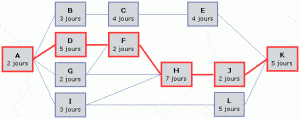 Like the Gantt chart, the PERT method (program evaluation and review technique) is also a technique used in project management to represent and closely monitor the progress of all tasks that make up a project. Thus, a dependency graph is used. In this graph, an earliest and latest start and finish date is highlighted, thereby facilitating the determination of the critical path.
It should be noted that there are two possible perspectives for determining this critical path. The first, indexed as “pert time” and which presents the critical path in terms of deadlines and schedules, is the more commonly used one. The other, named “pert cost,” presents the critical path in terms of expenses.
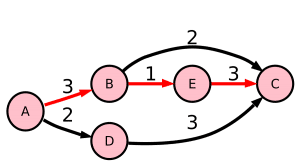 Used in the sense of “pert time,” the critical path will be defined as the longest sequence of activities that, throughout the project, should start and finish exactly as planned, in order to meet the project deadline. In other words, the critical path consists of those tasks whose total float (the difference between the latest date and the earliest date of a task) is zero.
In this way, to find the critical path(s) of a project (because there can be several), it is enough to identify the critical tasks on the PERT diagram that need to be linked together.