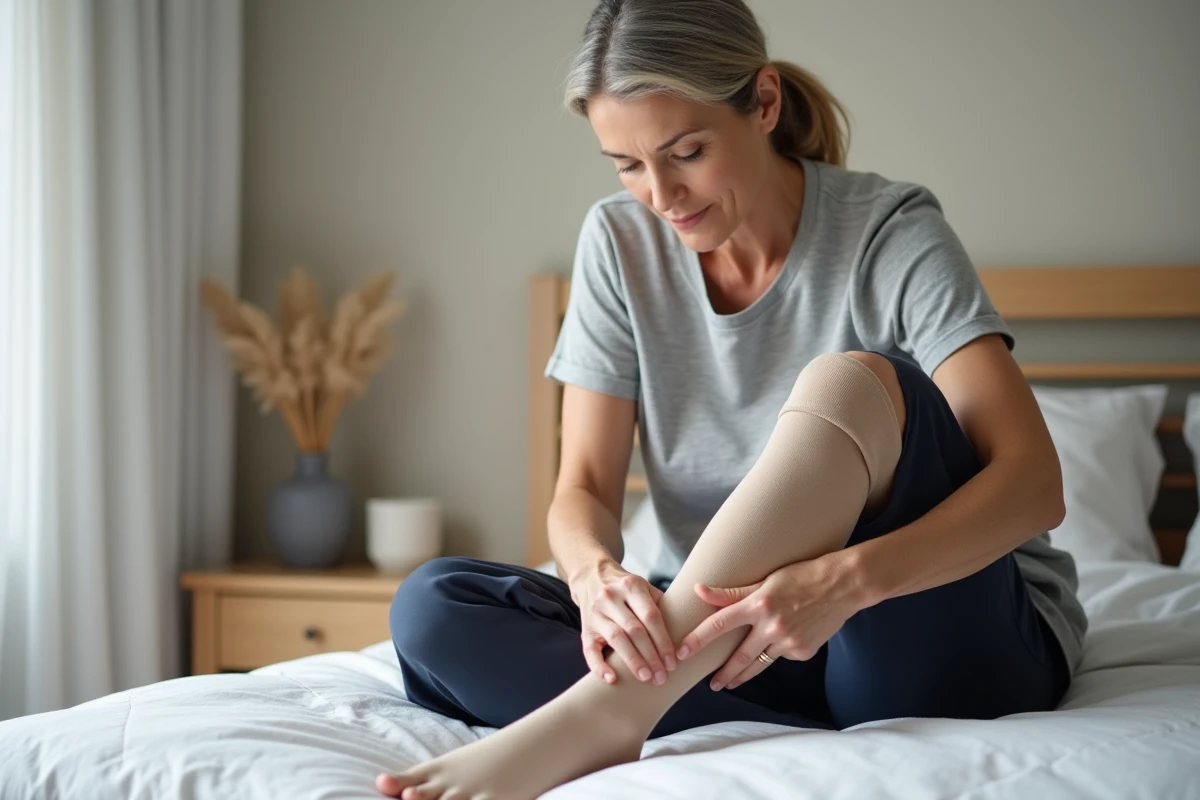
Compression stockings that slip down the leg throughout the day are a common inconvenience. This issue affects both people wearing stockings for the first time and those who have been using them for years. Several technical factors explain this slipping, and the solutions vary depending on the identified cause.
Silicone band and quality of hold: the first factor to check
The majority of current compression stockings are equipped with a silicone band at the top, designed to adhere to the skin and keep the stocking in place. This band is the main anti-slip mechanism.
Its effectiveness decreases over time. Repeated washing, contact with creams or body oils, and natural wear gradually reduce the adhesion of the silicone. A stocking whose band no longer sticks properly to the skin will slip, regardless of the initial quality of the product.
Before considering additional solutions, it is important to know how to keep compression stockings from slipping by checking the condition of this band. A gentle cleaning with a little warm water and neutral soap can sometimes restore some of the adhesion by removing greasy residues accumulated on the silicone.
- Apply any moisturizing cream at least one hour before putting on the stockings, to allow the skin to absorb the product and avoid a greasy film under the band.
- Regularly clean the silicone band with a damp cloth after each day of wear, without solvents or alcohol.
- Replace the stockings when the silicone band no longer regains its adhesive capacity despite maintenance, indicating that the material has reached the end of its life.

Size error: the most common cause of slipping compression stockings
A poorly sized compression stocking cannot stay in place. This is the most underestimated cause, and yet an inappropriate size causes the majority of slipping problems.
Manufacturers provide size charts based on several measurements: ankle circumference, calf circumference, thigh circumference for thigh-high stockings, and sometimes leg length. Taking measurements in the morning, before any swelling related to prolonged standing, skews the results. Measurements should ideally be taken late in the morning when the leg has a representative volume for the day.
A stocking that is too large does not exert enough compression on the leg. It tends to slide down under the effect of gravity because nothing mechanically holds it in place. Conversely, a stocking that is too tight at the thigh can roll on itself and form a tourniquet, which paradoxically also causes it to slip.
Check the prescribed compression class
The compression class (from 1 to 4 in France) determines the pressure exerted by the stocking. Wearing a class that is too low for one’s body type contributes to slipping, as the fabric does not fit the leg closely enough. The medical prescription must correspond to the actual need, and the choice of model must respect this class.
Fitting techniques that improve the hold of compression stockings
The way to put on a compression stocking directly influences its hold throughout the day. A stocking that is poorly positioned from the start will accumulate folds at the knee or ankle, creating areas of looseness that promote gradual slipping.
Turning the stocking inside out to the heel before putting it on allows it to be rolled down evenly along the leg. This technique avoids pulling and ensures an even distribution of compression.
Stocking aids (devices to assist with putting them on) are not only for people with reduced mobility. They also allow for more precise positioning of the fabric, without excessive hand contact that can shift the silicone band or create false folds.
The role of the skin in adhesion
Very dry skin offers less grip for the silicone than properly hydrated skin. The paradox: you need to hydrate the skin for the band to adhere, but without greasy residue at the time of application. The solution lies in hydrating the evening before rather than the morning of.
Some people have hair or skin texture that naturally reduces adhesion. In these cases, additional accessories like clip-on garters (which attach to a garter belt or waistband) provide mechanical support independent of the silicone band.

Model choice: tights, thigh-highs, or compression socks
The type of model plays a direct role in hold. Compression tights, by definition, do not slip down the leg since they are held at the waist. For those facing chronic slipping despite correct sizing, switching from thigh-highs to compression tights often resolves the issue.
Compression socks (which stop below the knee) slip less than thigh-highs because the calf area provides a natural curve that holds the fabric. However, they may not be suitable for all prescriptions, particularly those requiring compression along the entire length of the leg.
- Thigh-highs with a wide silicone band (at least three centimeters) hold better than those with a thin band, as the adhesion surface is larger.
- Models with micro-silicone bands (small dots rather than a continuous band) are better suited for sensitive or reactive skin.
- Tights remain the most reliable solution in terms of hold, at the cost of sometimes reduced comfort in warm weather.
Maintenance of compression stockings and lifespan of hold
Washing in hot water damages the elasticity of the fabric and the adhesion of the silicone band. A cold wash or at a maximum of 30 degrees, without fabric softener, preserves the mechanical properties of the stocking.
Fabric softener leaves a film on the fibers and on the silicone that significantly reduces adhesion. It is one of the most counterproductive maintenance practices, yet one of the most common.
Flat drying, away from any direct heat source, completes the good practices. A well-maintained compression stocking retains its holding and compression properties for several months of daily use. Beyond that, even with rigorous maintenance, the fabric gradually loses its elasticity and the silicone band its adhesive power.
The slipping of compression stockings is not a foregone conclusion. Most of the time, the problem can be resolved by identifying a single factor among size, maintenance, or fitting technique. When these three parameters are mastered and slipping persists, switching to a different model (tights or wide-band stockings) remains the most straightforward option.