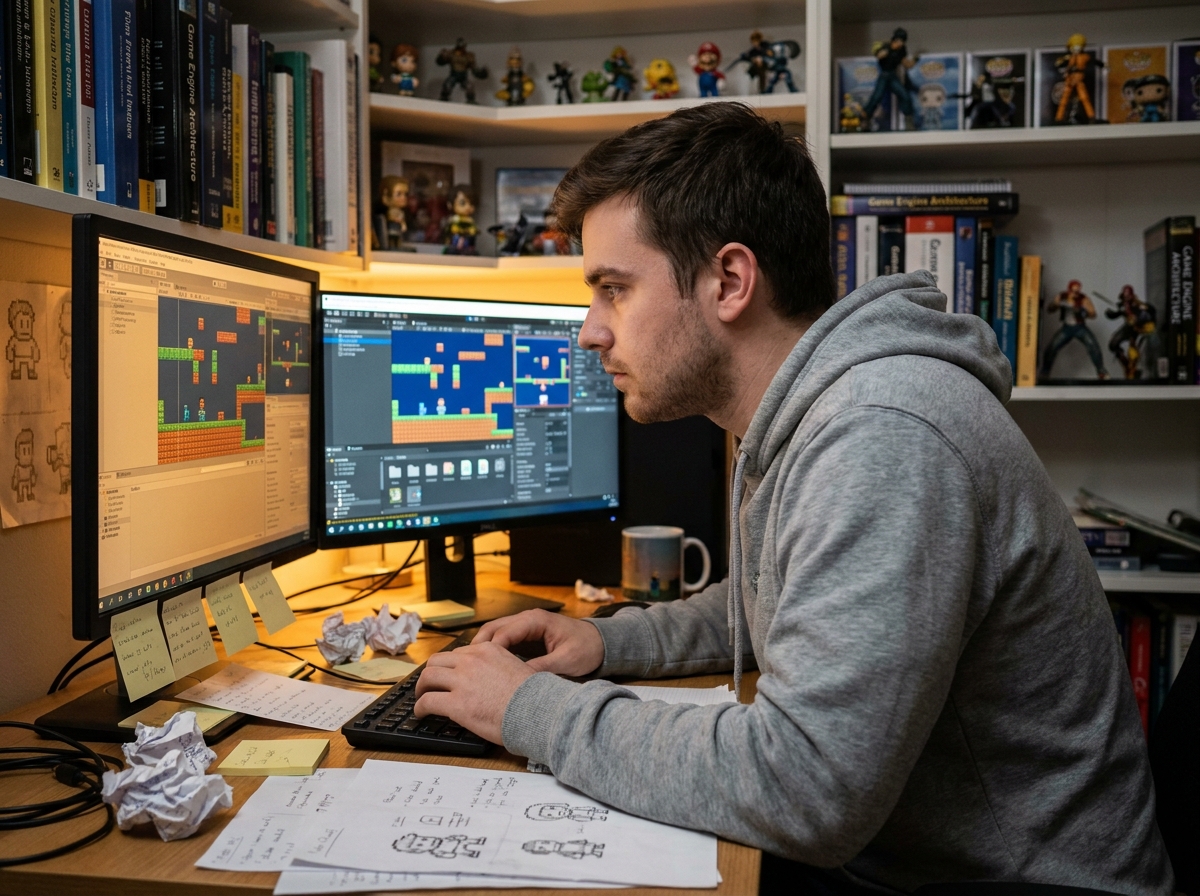
What engine to choose, what training to follow, what first project to undertake? For a video game enthusiast without a technical background, these questions shape the future of their journey. Rather than listing generic advice, this article compares the tools and accessible entry paths for beginners in France, supported by data.
Free game engines for beginners: Comparing Unity, Unreal Engine, and Godot
Recent guides for beginners recommend starting directly with free professional engines rather than closed “no code” tools. The reason is simple: a project created on a professional engine can be published on Steam, consoles, or mobile stores, which already constitutes a portfolio piece.
| Criterion | Unity | Unreal Engine | Godot |
|---|---|---|---|
| Main language | C# | C++ / Blueprints (visual) | GDScript (similar to Python) |
| Free license | Yes (under revenue threshold) | Yes (royalties beyond a threshold) | Yes (open source, no restrictions) |
| Preferred game type | 2D and 3D mobile/PC | High-fidelity 3D, AAA | 2D, small 3D games |
| Learning curve | Moderate | High without Blueprints | Gentle |
| French resources | Numerous (tutorials, online courses) | Growing | Active community, translated docs |
For a first solo project, Godot offers the quickest onboarding thanks to GDScript, a language similar to Python. Unity remains the dominant choice in French job offers, making it a more directly monetizable investment. Unreal Engine, on the other hand, is more suitable for those aiming for realistic 3D, but its initial complexity can be discouraging without support.
The key takeaway: choosing a professional engine from the start avoids having to relearn everything later. A small game published on Unity or Godot carries more weight than a prototype on a closed tool.

Video game training without a diploma: pathways taking shape in France
The classic path to becoming a video game designer typically involves a minimum of a bac + 3, with a starting salary around 2000 euros gross according to Onisep. However, this model is no longer the only one.
An increasing number of organizations offer short, professional, and 100% online training programs accessible with just a bac or personal experience. This type of pathway allows one to get started in video game creation as a beginner without going through a lengthy university cycle.
However, these short courses do not replace a solid portfolio. Studio recruiters, even for junior positions, assess completed projects before considering the diploma.
- Short online courses cover programming (C#, GDScript), game design, and project management, often in just a few months.
- Specialized post-bac schools (three to five-year programs) offer a network and internships in studios, an advantage for landing a first permanent contract.
- Self-training through the official documentation of Unity, Unreal, or Godot remains free and allows for progress at one’s own pace, provided one structures their learning independently.
Junior game designer job market in France: where the positions are
The junior job market in video games in France has long been seen as a bottleneck. Job postings on major French job boards have shown a different trend since 2024: beginner game designer positions are increasing, particularly in permanent contracts within small structures.
Independent studios, serious games companies, and digital agencies are hiring junior profiles, not just major AAA studios. This diversification changes the game for beginners: applying to a ten-person studio developing an educational game or a simulation tool does not require the same level of experience as a position at a major publisher.

The skills sought at this level are not limited to programming. The ability to document a game design (writing a GDD, formalizing mechanics), to prototype quickly, and to work in a team using versioning tools (Git) are part of the concrete expectations.
The technical skills that make a difference on a junior CV
A portfolio of two or three small playable games weighs more than a list of mastered languages. Recruiters check if the candidate can manage a project from start to finish: design, code, test, publish.
- Proficiency in a game engine (Unity or Godot for most junior positions in France).
- Ability to write a clear, structured, and iterative game design document.
- Basic knowledge of versioning (Git) for collaborative work.
- Experience participating in a game jam (time-limited game creation event), which proves the ability to deliver under constraints.
First video game project: where to start concretely
The classic trap for beginners is to aim for a project that is too ambitious (an open-world RPG, an MMO) and to abandon it after a few weeks. A completed and published game is worth infinitely more than an unfinished ambitious project.
The most common recommendation in developer communities (r/gamedev, Unity forums) is to replicate a simple game that already exists: a brick breaker, a single-level platformer, a minimalist puzzle. The goal is not originality, but a complete understanding of the production cycle, from idea to publication.
Once this first game is completed, participating in a game jam (Ludum Dare, Global Game Jam) allows for teamwork, meeting a deadline, and receiving external feedback. These events are free and open to all levels.
The path to becoming a video game creator from scratch relies less on the initial diploma than on the ability to produce, publish, and iterate. The tools are free, short courses are multiplying, and junior positions in France are no longer limited to major studios. The determining variable remains the portfolio: two small playable, documented, and published games open more doors than a CV without a concrete project.